Siddhartha and Transcendentalism
Joseph Campbell’s penultimate step in the monomyth “The Master of Two Worlds” is an admittedly confusing one in the context of Siddhartha. This is owed in no small part to the fact that many of the final steps listed by Joseph Campbell seemingly mold together in Hermann Hesse’s novel. Steps like “The Ultimate Boon,” or “Magical Flight” quickly ease into the next one or gloss over one another entirely. In the context of Siddhartha, I would argue that the Ultimate Boon is the Siddhartha’s realization that he has become the “Master of Two Worlds.” Any further difficulty in applying Campbell’s monomyth to the text hereafter can be derived from the inherent difficulty in pinpointing the chronology of this realization in the text. I, myself, in struggling to select a passage that encapsulated the ideas of the “Master of Two Worlds” (in which the protagonist’s “ambitions being totally dissolved, he no longer tries to live but willingly relaxes to whatever may come to pass in him; he becomes, that is to say, an anonymity” (Wikipedia)), opted to use some rudimentary literary rule of superposition and observe the end of the novel, wherein the end of the Hero’s Journey would most likely reside. It is here in these closing passages where Siddhartha meets for the last time with Govinda and discloses his final philosophies to his friend. Hermann Hesse capitalizes on these concluding moments to preach his version of Emerson’s transcendentalism which, itself, permeates throughout the novel. The Master of Two Worlds in Siddhartha is the ability to realize that one’s world is complete only through the inclusion and necessity of sustaining both samsara and nirvana, sin and virtue, the material world and its spiritual contrary.
This is undoubtedly emphasized during the confession between Siddhartha and Govinda on page 143, “...then the dividing line that seems to lie between this world and eternity, between suffering and bliss, between good and evil, is also an illusion.” While this shocking revelation also serves to subvert the earlier step of temptation (wherein Siddhartha immerses himself in the world of Kamala and Kamaswami) in a sort of retrograde romanticization of his menagerie of vice (Les Fleurs du Mal), it also bears much resemblance to Emerson’s idea of self-reliance and nonconformity. The theme of nonconformity is itself inherent in every aspect of Siddhartha. From its eastern setting to its moral message proclaiming the necessity of sin, Hesse’s novel, while not necessarily a reaction to the protestant Germany or lifestyle that Hesse found to be overbearing (see Hesse’s Beneath the Wheel), operates in a world outside Christendom and into the undeniably pagan. Emerson, himself, proclaimed a similar message in his essay Self-Reliance during a defense of the “integrity [of the] mind.” Not only did Emerson echo Siddhartha’s message of the importance of nature and utilization of one’s own moral judgement for what is good (or rather what is necessary for enlightenment), Emerson took it a step farther to state (upon having his ideas accused of being heretical by a friend) that “They do not seem to me to be such; but if I am the Devil’s child, I will live then from the Devil.” It is hard to discern whether Siddhartha’s idea of nonconformity, itself forming the basis of the “Master of Two Worlds” step, is more radical than Emerson’s pseudo-sacrilegious statements. I believe that the primary transcendentalist idea being conveyed in Siddhartha’s “Master of Two Worlds” step (although containing a certain, perhaps unnuanced, provocative nature) is that the material world is interchangeable with the idea of sin and vice, and thus, mastery of both worlds requires some sort of personal comprehension of evil or self-realization of original sin inherent in human beings.
Hermann Hesse’s idea of Siddhartha is further synchronized with that of Emerson’s transcendentalism upon the shared notion of the “dissolving ambitions” in the Master of Two Worlds step as expressed by a collection of volunteer contributing writers (Wikipedia Hero’s Journey, see above). Early in Self-Reliance, Emerson argues against the human impulse to travel beyond one’s own home. In the following passage, Emerson states that any wise man does not need to look beyond his own domain for enlightenment, “The soul is no traveller; the wise man stays at home, and when his necessities, his duties, on any occasion call him from his house, or into foreign lands, he is at home still… that he goes the missionary of wisdom and virtue, and visits cities and men like a sovereign, and not like an interloper or a valet.” The Hesse analogue here being Siddhartha’s gradual regression from society and into river hut life. Upon being over-satisfied with “life amongst the children,” Siddhartha resigns his mercantile ambitions in order to now master the second world, the spiritual.
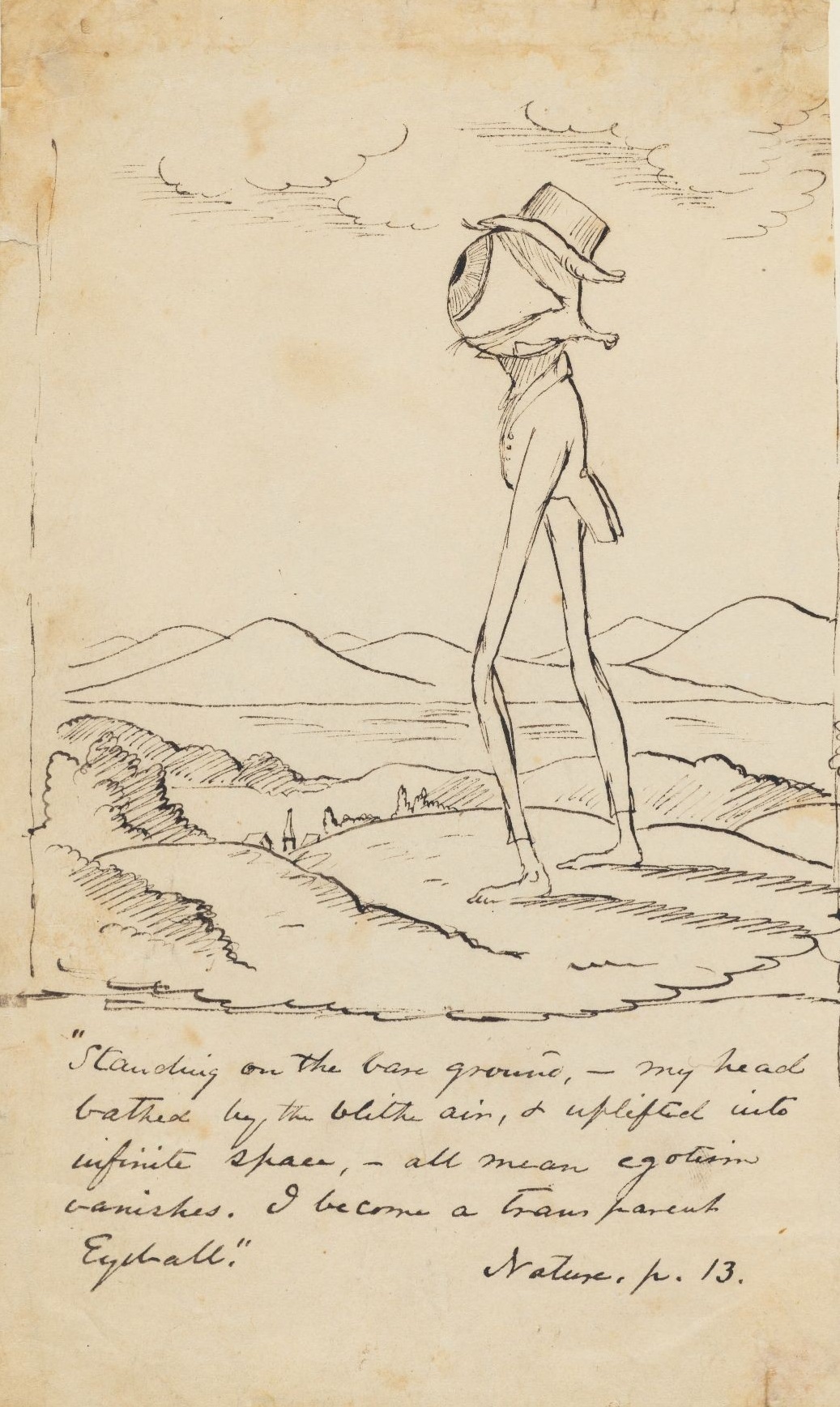
*The “Transparent Eyeball” (Nature, Emerson) concept is reflective of Siddhartha’s latter methods of approaching enlightenment as an isolationist outside observer of the environment removed from society.

While, it is not a certain fact that Hesse was familiar with the American-originating transcendentalist philosophy (though it is very unlikely, as an author, that he was unaware of it), the similarities between the independent man propagated in Emerson’s works and the concepts of self-actualization represented by the monomyth make (by transitive property) resemblances between Siddhartha and transcendentalism inevitable nonetheless. In conclusion, Siddhartha’s “Master of Two Worlds” emphasizes the idea of a balance between good and evil, material and spiritual, society and isolation etc. that mirrors/evolves upon Emerson’s contrast between the self and external influence.


This comment has been removed by the author.
ReplyDeleteThere's a lot of gray area when it comes to unpacking Hesse's real intentions behind this novel. Even more annoyingly, things are certainly complicated by the fact that we don't have access to the original German prose. That said, there's a lot of good parallels being drawn in this post that help clear up Siddhartha's purpose while also identifying a few important Hero's Journey stages. Hesse and Europe's fascination with Eastern mystique (India, China, etc.) serves as an overtly Nietzschean "Death of God" commentary on the abandonment of spiritualism in the modern West, which, in my opinion, lines up nicely with the strong themes of Christianity in Emerson's writing which you dug into. Nice post, Ben!
ReplyDeleteWow, I didn't think Siddhartha was this complex but you proved me wrong! After researching a bit on Transcendentalism and re-reading your article, I'm shocked by how much this philosophy is connected to the core messages encapsuled in Siddhartha. I think you did an awesome job at not only analyzing Herman Hesse's novel Siddhartha but also taking it a step further and finding connections. In future discussions of Siddhartha, I would like to discuss this with the class and truly dive deeper into this topic. Awesome post Ben!!
ReplyDeleteBen, this post is certainly in a class of its own. Many of your points and analyses here are undoubtedly deserving of their own blog post, and particularly your analysis of the thematic structure in context of Emerson's transcendental ideas is subtle, but in retrospect enlightening. Siddhartha, as a European telling of a distinctly East Asian religious ideology, inherently contains some commentary on some values of Europe (i.e. Christianity) contained in the framing of the Eastern religion, and the alignment with Emerson's transcendentalism captures this well. Nice post.
ReplyDeleteHi Ben, this post is simply breathtaking. I had never considered the philosophy of Siddhartha in such a complex sense, but your post really enlightens me to that end. I love your parallels to the 'transparent eyeball' as well- it gives a visual metaphor of the way Siddhartha approaches the world. Excellent post!
ReplyDeleteBen, you did a great job unpacking this topic and analyzing the idea of transcendentalism from Emerson. The complexity displayed in this post makes it an informative and intriguing read. I think your eyeball image shows the connection between Siddhartha and this transcendentalism idea. Nice work.
ReplyDeleteGreat post Ben! Your complex interpretation of Hesse's intention's behind Siddhartha shows the affects of both Christendom and paganism throughout Siddhartha. While I had never considered Hesse's religious and ethnic background while reading Siddhartha, your explanation of Hesse's connection to both Christianity and paganism allows me to draw parallels between Hesse's personal religious background and the setting and religious parts of Siddhartha. I wonder if Hesse would refer to Emerson's beliefs and heresy as an acceptance of sin and vice, that you embrace contradictory beliefs to reach true enlightenment.
ReplyDelete